The Grand Canyon: The Hike That Didn’t End the Way We Planned

The Grand Canyon: The Hike That Didn’t End the Way We Planned
April and I started planning our Grand Canyon trip in February 2025. Our hike wasn't until October 7, so we had eight months to prepare. That sounds like plenty of time, but it didn't feel like it. From the beginning, I knew this wasn't going to be one of those trips where you book an Air BnB, show up and figure things out when you get there. The Grand Canyon is not the place you wanted to wing it. I wanted to know what we were getting ourselves into, how to prepare for it and, most importantly, how to get ten people into the canyon and back out safely.
So, we started researching, and when I say researching, I mean we became a little obsessed. We started listening to the Hiker Dude podcast constantly—while driving, working, doing things around the house, pretty much anytime we could listen. We also started reading books about hiking the Grand Canyon, including some that seemed to have one primary objective: teaching you how not to die in the Grand Canyon. Honestly, that seemed like a pretty reasonable place to start.
One of the first things we realized was that when you go matters almost as much as how you prepare. The heat in the canyon can be brutal, so we wanted to choose a time of year when we could actually enjoy the hike without dealing with the worst of the summer temperatures. But we are also coming from Georgia and had no interest in hiking the Grand Canyon in snow and freezing temperatures either. October seemed like a pretty good compromise, so October it was. The official date was determined closer to trip time based on the weather.
At first, our plan was to hike Rim to Rim, starting at the South Rim and finishing at the North Rim. From there, we would make the roughly four-hour drive back around to the South Rim. The more we learned, though, the more we realized just how much went into a hike like this. We weren't talking about a normal day hike. We were talking about miles of elevation change, heat, water, food, timing, transportation and ten people who all needed to make it through the canyon.
Later in 2025, April and I enlisted the help of Coach Arnie, a local coach in Arizona and Grand Canyon expert whom we became familiar with through the Hiker Dude podcast. He helped us work through the logistics of getting everyone to the trail and, more importantly, helped us figure out a route that would work for our group.
Then, just when we thought we were getting everything figured out, the Dragon Bravo Fire changed our plans. The fire, which started by lightning on July 4, 2025, caused significant damage to the North Rim. The Grand Canyon Lodge and numerous historic structures were destroyed, and the North Rim and North Kaibab Trail were closed because of the fire and resulting safety concerns. Phantom Ranch was also closed at the time of our trip. Our original Rim-to-Rim plan was no longer possible.
Back to the drawing board we went, with Coach Arnie helping us figure out what our new plan should look like. After more conversations, research, map studying and planning, we finally came up with a route that seemed like it would work for our group. We would start at the South Kaibab Trailhead, make our way down to the Tonto Trail, cross over toward Bright Angel, continue down to the Colorado River, cool off for a little while and then make the long climb back up Bright Angel.
There were ten of us, and now we had to figure out how to get all ten people through the Grand Canyon in one day without putting us in the wrong place at the wrong time. I mapped out the entire day, including when we needed to start, when we needed to reach certain sections of the trail, how long we could spend at lunch, when we needed to reach the river and when we needed to start climbing back out. I was getting feedback along the way from Coach Arnie to make sure my plan was feasible.
I knew there were two places on our route where I absolutely did not want us to be during the hottest part of the day. The timing mattered, but I also knew this was our first time in the Grand Canyon and we weren't going to rush through it just to stick to a spreadsheet. We were going to stop for pictures, enjoy the views and take it all in. I built some flexibility into the schedule for that.
Our planned start time was around 5:30 AM, with a goal of being back at the rim somewhere around 8:00 PM. The closer October 7th (the official hike day) got, the more real it became. For months, this had been maps on a computer, podcasts in my ears, books on my nightstand and conversations around the dinner table. Now it was almost time. Ten people were counting on the plan, and I wanted everyone to have an incredible experience. More importantly, I wanted everyone to come out of that canyon safely.
The Night Before
Everyone was staying in Sedona, but we made a last-minute decision to get a hotel—or actually a couple of hotel rooms—near the canyon the night before. It didn't make sense to have ten people getting up at 2:00 AM to make the two-hour drive to the canyon and then attempt a hike that was going to take all day and into the night.
We arrived at the Grand Canyon in the late afternoon and, of course, we couldn't just sit around and wait for the big hike. We did a few short hikes around the canyon, took pictures and watched the sunset. Everyone was excited, and the anticipation was getting harder to ignore. In less than twelve hours, we were going to be walking down into that canyon.
We grabbed dinner and headed back to the hotel. Our food was planned, our gear was ready and everything was laid out. We had been talking about this hike for months, and now we were finally there. We double-checked the alarms and then checked them again. We had to get up on time. The entire plan depended on getting an early start so we could get through the Tonto Trail before the middle of the day, when the sun would be at its hottest.
After eight months of planning, research, route changes, maps, podcasts, conversations and preparation, the big day was finally here.
Except it wasn't exactly starting the way we had planned.
We woke up late.
The alarm had not been set to AM.
Yep. We were a good thirty minutes behind schedule before our feet even hit the floor.
Everyone jumped up, got dressed, grabbed the breakfast we had thankfully already planned out and packed, and headed for the door. Our transportation from the parking area to the South Kaibab Trailhead was already arranged, and thankfully Mom and Pop Fambrough were our morning taxi service. They got us where we needed to be, and by about 5:45 AM, we were at the trailhead and ready to go.
We were about fifteen minutes behind my scheduled start time, but that was okay. I had built some flexibility into the schedule, and we were still on track. So, we turned on our headlamps and started down South Kaibab.
Into the Canyon

Walking down South Kaibab in the dark was something I will never forget. We could see the trail in front of us, but everything around us was still mostly black. There is something pretty surreal about walking into one of the biggest places you've ever seen when you can't even see where you're going.
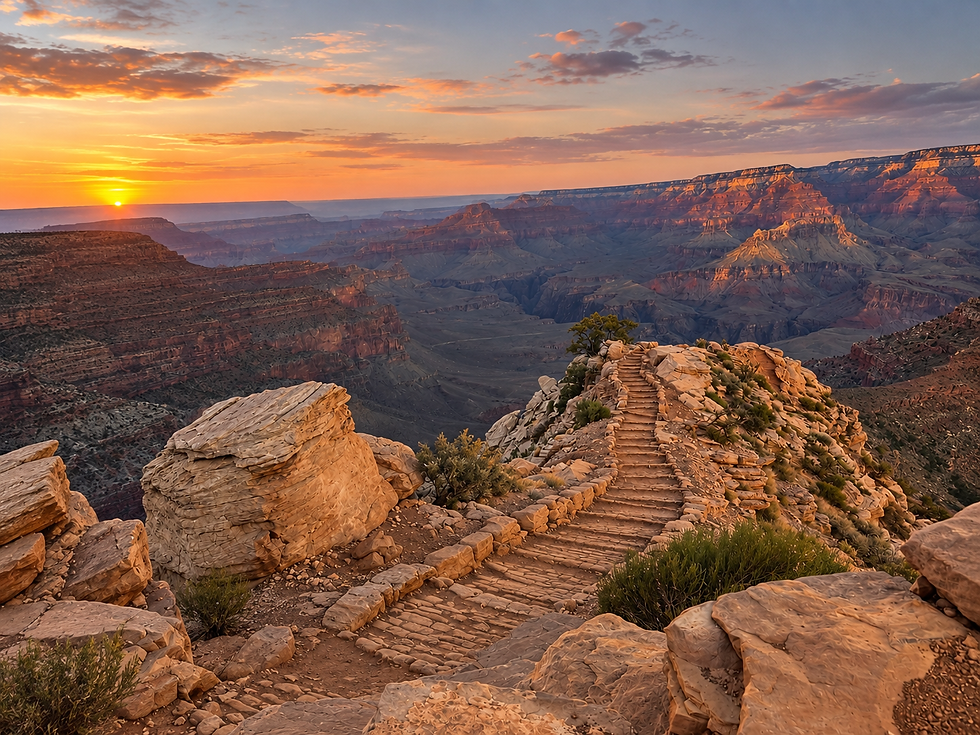
About an hour into our descent, the sky started to change, and we were rewarded with an incredible sunrise. We stopped several times along the way to take pictures and take in the views. I don't think it's possible to actually take in the Grand Canyon, especially the first time you see it from inside the canyon. You can look at pictures, listen to podcasts, read books and study maps, but none of that really prepares you for standing there.
For the next few hours, I was doing what I love to do—hiking, talking with my friends, taking pictures and enjoying the experience. But I was also keeping an eye on the clock. I knew our descent would be slower than what I had mapped out because there was no way we were going to walk through the Grand Canyon for the first time and not stop to look around. I had planned for that.
As we reached the Tonto Trail, we were right on schedule. Now we needed to keep moving toward Bright Angel. Our next big goal was to reach Havasupai Gardens around lunchtime. Havasupai Gardens is about 4.5 miles down Bright Angel from the South Rim and has potable water, restrooms, a ranger station and places to stop and rest, making it a natural place for us to take a longer break.
And we made it. We were only about fifteen minutes behind my predicted time.
That first descent and the miles across the Tonto Trail had definitely taken something out of everyone. We were all ready to sit down. We were hungry, tired and ready for a break. I had planned for an hour of downtime, although I was secretly hoping we'd keep it closer to forty-five minutes so we could make up some of the fifteen minutes we'd lost.
After lunch and some much-needed rest, we were back on the trail. Now we were heading farther down toward the Colorado River. It was warmer, but the weather really couldn't have been much better for what we were doing. The direct sun was definitely noticeable, but the shady spots felt amazing.
And then there were the miles. Those six miles toward the river felt like sixty. I could not wait to get those shoes off. All the way down it was, “We are almost there,” “Just around the bend,” “Just a little further.” We still joke about that today.
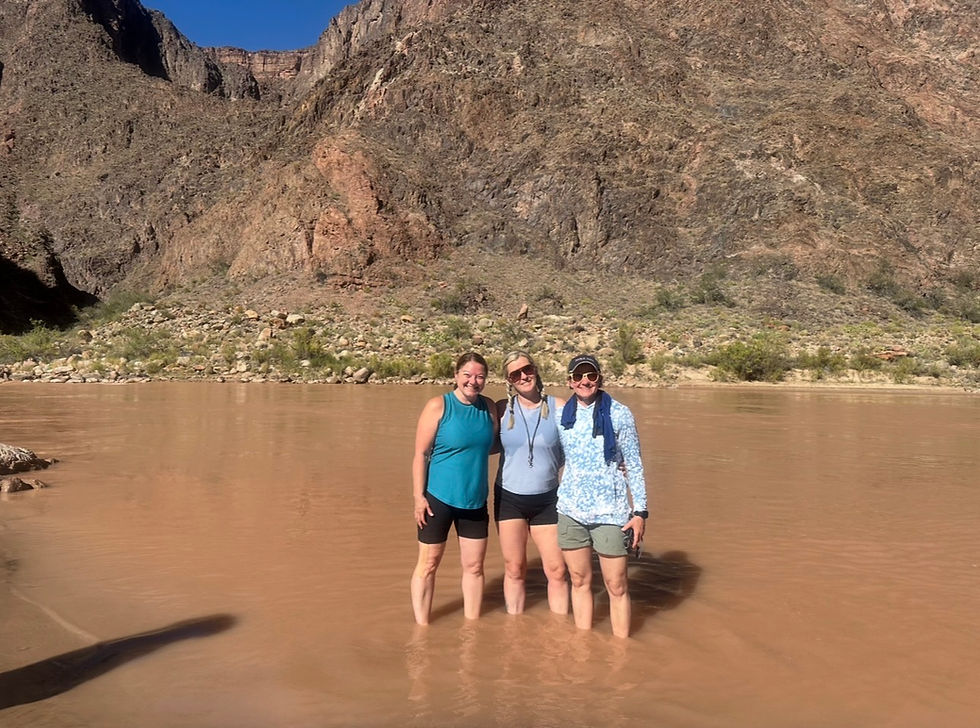
When we finally reached the Colorado River, that's exactly what we did. Shoes off, feet in the water. And it was COLD. But it felt amazing.
We all got in for a quick dip, grabbed some snacks and enjoyed being there. We stayed a little longer than planned, but at that point, it was a welcome delay. We still had time. We could make it back to the rim around 8:30, and the pizza place closed at 9. I was already thinking about that pizza.
Around 4:00 PM, we started the long climb back up Bright Angel.
The climb was hard. We had already been hiking for hours, and now we were going uphill. Everyone was starting to feel the day's miles, and the pace was slowing down. We stopped again at Havasupai Gardens to refill water and get more food in us. I don't remember the exact time, but I know we were still looking at an 8:00–8:30-ish finish.
We probably rested a little longer than we should have, but looking back, I think we needed it. We had been moving for most of the day, and sometimes you have to give your body a chance to find that second wind. One thing I had learned from all those podcasts and books was that you need to keep eating, even when you don't really want to eat anymore. You need calories, fluids and electrolytes. So, we ate, drank and started climbing again.
Some people were moving a little slower now, and the sun was beginning to set. As we continued up Bright Angel, the group started to separate. I didn't want that, especially with darkness coming. We all had headlamps or some kind of light, and we'd been communicating all day with walkie-talkies, one with the lead hiker and one with the caboose, so we could keep track of what was happening at both ends of the group.
But the gap was getting bigger, and I was losing my patience. I let the group know over the walkie-talkie that we needed to keep everyone together. The people toward the front slowed down and held back while the back half made a much-needed stop at the 1.5 Mile Resthouse.
That last section is tough, and by now it was almost completely dark. The big, bright moon overhead was helping delay the feeling of complete darkness just a little, but there was no question that we were finishing this hike at night.
We finished our stop, had a sip of water, grabbed another snack and started moving again. We hadn't gone more than a few hundred feet when I saw the rest of our group standing in a semicircle.
Immediately, I knew something was wrong.
This wasn't everyone simply waiting for us to catch up. Someone was in trouble.
My first thought was that one of our own people was hurt or sick. That was my biggest fear from the beginning. I didn't want anyone in our group to have a bad experience because we hadn't prepared properly for a hike.
But it wasn't one of us.
There was a young man sitting on the ground, visibly shaking and not looking good at all.
And just like that, firefighter rescue mode kicked in.
First, assess the situation.
I started asking questions. How long had they been there? What had he eaten? What had he had to drink? Was he in pain? Was he nauseated? His friend was with him—an older gentleman who didn't look like he was doing particularly well himself.
From what we could determine, the young man was likely dehydrated and hadn't taken in enough food for the demands of the hike. His legs were cramping so badly that he couldn't walk.
We asked if they had called the rangers. They had. But this was October 2025, during the federal government shutdown, when Grand Canyon services were operating with reduced staffing. We were told that if he couldn't get himself out, they should call back in two hours. I can't independently verify that exact conversation, so that's how we understood the situation that night.
Two hours?
Looking at this kid, I knew he didn't have two hours. The sun was gone, the temperature was dropping quickly and he was already in serious trouble. His legs weren't working.
We weren't leaving him there.
Everyone went into rescue mode. Thankfully, we had three big, strong guys with us. They were exhausted from the day's hike too, although I don't think they realized just how much they still had left in the tank.
They took off their packs, and the rest of us redistributed the weight. Then the guys took turns carrying the young man up the hardest part of Bright Angel—the final 1.5 miles to the rim. We started the slow trek upward, stopping frequently to let the guys switch out and rest. All the while, we were getting water, electrolytes and food into our distressed hiker.
His name was Aaron.
We will never forget that name.
After what felt like a hundred miles, but was actually probably a mile or so, I finally made a decision.
“Aaron, you have to walk, we were done carrying you." Not because we didn't want to help him, but because we couldn't keep carrying him at that pace and still get everyone out in a reasonable amount of time. And our guys were exhausted. I didn't want to risk getting one of them injured for the sake of helping someone who had been ill-prepared for his adventure.
I told him we would keep the guys right beside him in case he needed help, but he had to start walking.
He had plenty of recovery time. He had food, fluids and electrolytes. But he had to move.
And he did.
Slowly, he started walking. One step at a time. With each step, he seemed to get a little better. It wasn't fast, but it was forward.
Around 9:30 PM, we finally reached the top.
And there was no pizza.
There was no celebration, no high-fives and no big group picture celebrating the successful completion of the hike we'd spent months planning.
Thankfully, Aaron and his friend had parked close by. The nurse practitioner in our group, along with pretty much everyone else, strongly encouraged them to go to the emergency room. I really hope they did.
It was around 10:00 PM when we finally parted ways. We got back to our cars, loaded everything up and started the roughly two-hour drive back to Sedona.
Tired.
Hungry.
And, unfortunately, pizza-less.
I'll be honest. It was a disappointing end to the day. Not because we hadn't accomplished what we had come there to do. We had. We had successfully made our way into the Grand Canyon and back out. We had followed a route that wasn't even our original plan. We had stayed together, managed our food and water, watched the sunrise, walked across the Tonto Trail, reached the Colorado River and climbed back out.
We did the thing.
But we didn't get the ending I had pictured. There was no sitting around together with a big pizza, laughing about the day's adventures and celebrating what we'd just accomplished. Instead, we were driving through the darkness toward Sedona, tired and hungry, wondering what was going to happen to a guy we'd met only a few hours earlier.
I believe everything happens for a reason.
Maybe we were exactly the people who were supposed to find Aaron that night. We had people with medical knowledge. We had people who knew how to assess a situation. We had strong people who were willing to carry him. We had food, water and electrolytes. We had communication.
And most importantly, we had a group of people who weren't going to walk away and leave someone behind.
That part felt very familiar to me.
For more than twenty years, I was part of a profession where you showed up for people you'd never met. You helped strangers. Sometimes you put yourself in dangerous situations for someone whose name you didn't even know. And most of the time, you never found out what happened after you left.
There isn't always a reward. Sometimes the reward is simply knowing you did the right thing.
But the more I think about that night, the more I realize something else.
We all felt inconvenienced by Aaron.
Nobody said it. Nobody complained about it. But let's be honest—we had been hiking for fourteen hours. We were exhausted. We had a plan. We were trying to get back to the rim. We were hungry, tired and looking forward to that pizza. Suddenly, our plans didn't matter anymore.
And maybe that's exactly what we needed.
Because just before we found Aaron, several of us were getting close to our own breaking point. We were hurting. We were tired. We were frustrated. We were having those thoughts that creep in when you've been pushing for a long time and you're wondering how much more you have left.
Then someone else needed us.
And suddenly, we had more.
The sore feet didn't matter. The tired legs didn't matter. The aching knees didn't matter. The negative thoughts didn't matter. Nobody was asking how much farther we had to go anymore. We had something more important to focus on.
In a strange way, Aaron helped us just as much as we helped him.
We helped him physically get out of the canyon when he couldn't do it on his own. But he unknowingly helped us find another gear and pull together as a team when we were getting close to our own limits.
Sometimes you don't realize how much you still have left in you until someone else needs you to find it.
I still think about Aaron from time to time. Did he go to the emergency room? How sick was he? Was he admitted? Did he wake up the next morning and feel okay? Will he ever hike the Grand Canyon again?
I have no idea.
I hope he's okay. I hope he learned something from that day. And I hope someday he tells someone about the group of ten strangers who found him on Bright Angel Trail and decided they weren't going to leave him there.
As for us, we'll hike again. We already have.
Did Aaron ruin our big finish?
Yeah. He kinda did.
But what was the alternative?
Until next time—we'll see you again, Grand Canyon.


Comments